
The Almanac
Lingonberry
The Brightness of Resilience
Lingonberries bring a vivid presence to the northern landscape.
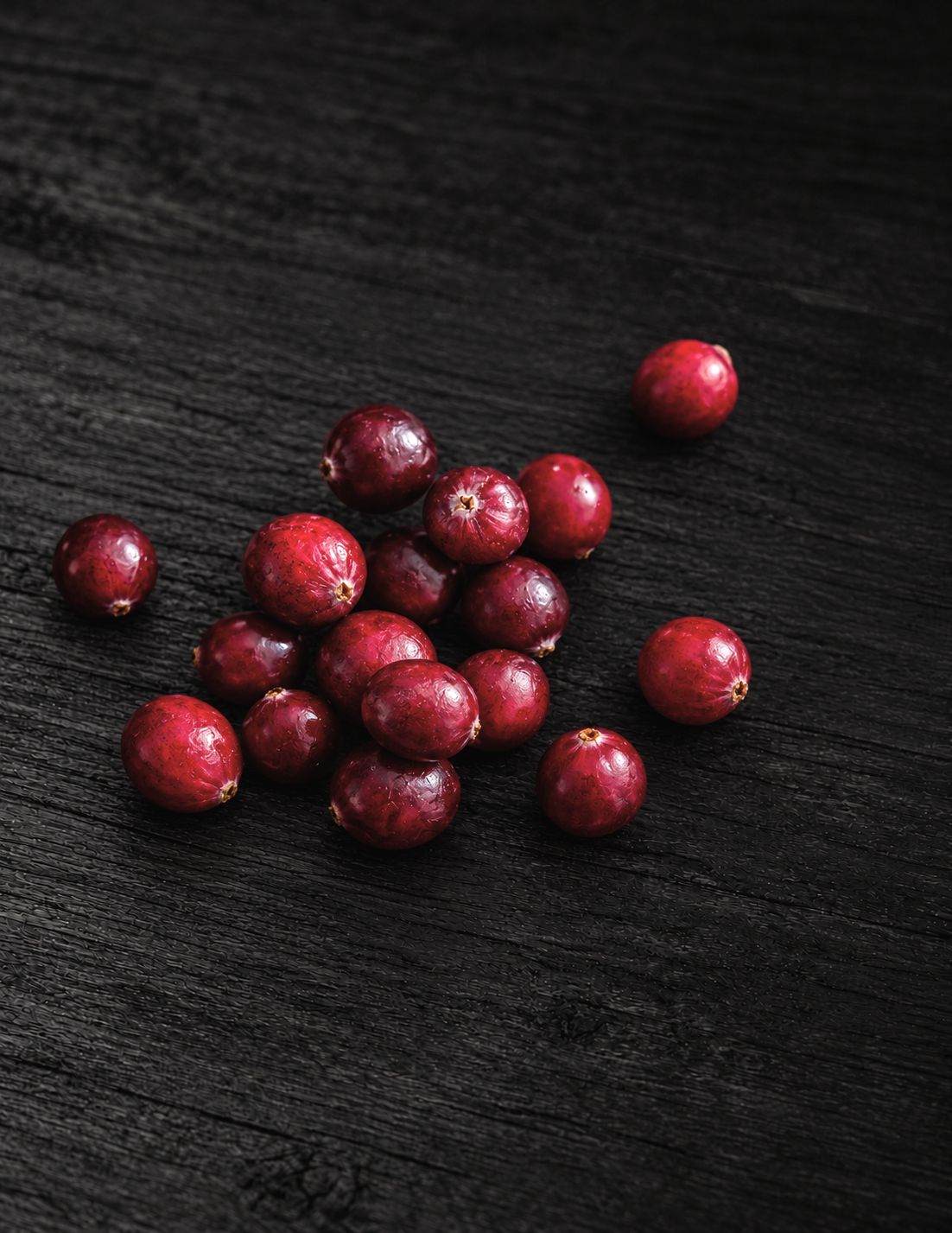
Small and red, they grow on low evergreen shrubs, their bright fruit standing against glossy leaves and the muted textures of the woodland floor.
That contrast draws me in.
Their flavor has a similar clarity—tart, gently bitter, and unmistakable beside richer ingredients.
Even a thin layer can change the experience of a cake.
A flash of fruit.
A welcome sharpness.
A color that carries from the inside out.
From Woodland to Table
Lingonberries hold an enduring place in Nordic traditions of gathering and preserving food.
Their connection to the northern pantry interests me as much as their flavor. They invite me to consider the knowledge built through observing a landscape: recognizing what grows, knowing when to gather it, and finding ways to preserve the harvest.
My Nordic ancestry has long inspired my interest in nature, nourishment, ancestral healing traditions, and symbolism.
Working with lingonberries gives that interest a tangible form.
An ingredient I can taste.
A color I can study.
A connection I can explore through my own way of creating.
A Thread of Crimson
For Crimson North, lingonberry became the link between the cake’s flavor and its painted exterior.
Its deep red appears in the fabric beneath the warrior’s weathered armor and in the cord woven through her braids. Those accents bring warmth to the charcoal feathers and aged silver details.
The raven looks back while the warrior looks ahead.
Their opposing gazes became my expression of honoring what came before while finding a way forward.
Within that story, lingonberry represents resilience and continuity—a personal interpretation shaped by my relationship with heritage and the northern landscape.
The crimson thread carries that connection through the piece.
Lessons from the Berry
Working with lingonberries asks me to give tartness its own place.
Too much sweetness can soften the character that makes the fruit interesting. Too little can leave the filling sharper than the cake needs.
For Crimson North, I want the lingonberry compote to remain distinct beside brown-butter cardamom cake and toasted white-chocolate ganache.
The butter brings toasted warmth.
The cardamom adds fragrance.
The ganache offers creamy richness.
The berry brings brightness through them all.
Finding that balance means tasting each component separately, then returning to them together.
Each needs room to contribute.
Why It Matters
Lingonberry reminds me that inspiration can begin with something small.
A berry’s color becomes a fold of fabric.
Its tartness shapes a recipe.
Its place in a landscape opens a reflection on ancestry.
In Crimson North, those observations come together through flavor, sculpture, and painting.
A look back at my roots, carried into the work of my own hands.
Field Notes
Botanical Name
Vaccinium vitis-idaea
Origin
Native to northern regions across Europe, Asia, and North America
Botanical Connection
The fruit of a low-growing evergreen shrub in the heath family, Ericaceae.
Creative Associations
Resilience • Resourcefulness • Heritage • Reflection • Continuity
Flavor & Texture
Brightly Tart • Gently Bitter • Juicy • Firm-Skinned
Sweetness and intensity vary with ripeness and preparation.
Pairs Beautifully With
Cardamom • Brown Butter • White Chocolate • Vanilla • Apple • Pear • Orange • Almond • Rye • Sea Salt
A Symbol of Reflection
Tea has become a symbol of hospitality in countless cultures, but it also represents something more personal.
Reflection.
Unlike coffee, which often accompanies movement and momentum, tea asks us to linger.
To notice.
To sit with our thoughts a little longer.
That quiet rhythm has influenced the way I approach creativity.
Not everything meaningful arrives immediately.
Some ideas need time to steep.
Lessons from the Cup
The more I worked with black tea in baking, the more I realized it behaves much like creativity itself.
Steep it too briefly, and much of its character remains hidden.
Leave it too long, and balance begins to shift.
Understanding tea isn't about following a recipe.
It's about paying attention.
Temperature.
Time.
Strength.
Subtle changes that influence the final experience.
The same is true when composing recipes.
Or building a sculpture.
Or writing.
The details matter because they shape everything that follows.
Why It Matters
Black tea reminds me that depth cannot be hurried.
Whether infused into cream, steeped into syrup, folded into cake batter, or simply shared across a table, it asks us to appreciate the beauty that develops through patience.
Perhaps that is why I continue returning to it.
Not because it is dramatic.
But because it quietly rewards those willing to wait.
Field Notes
Botanical Name
Camellia sinensis
Traditionally Associated With
Reflection • Hospitality • Patience • Conversation • Ritual
Pairs Beautifully With
Cardamom • Honey • Bergamot • Orange • Pear • Vanilla • Brown Butter • Dark Chocolate • Cinnamon • Clove